Showing posts with label vocabulary. Show all posts

Sunday, March 2, 2014

Otto's Orange Day by Jay Lynch and Frank Cammuso

What do you remember learning in kindergarten?  The alphabet?  How to count all the way to 100?  I am sure that learning the colors would also be on that list.  As a kindergarten teacher, this is one of the first things my students learn.  Typically, we focus on one color at a time.  We name things that are red or purple or yellow, etc.  We sort colors.  We even learn color songs to help us spell the colors.

The next time I teach my students about the color orange, I will have to read the book, Otto's Orange Day by Jay Lynch and Frank Cammuso.
A level 3, Toon Book, Otto's Orange Day is designed to encourage young readers to enjoy reading. Otto is an orange cat who loves orange.  Its his favorite color.  One day, he received a special package from his aunt.  The box contained a magic lamp.  Otto began to dust the lamp when a genie appeared, offering him one wish.  Instantly, Otto knew that what he'd like most of all is for everything in the world to be orange.
Eventually, Otto learns that when everything is the same, life is boring and dangerous.  Together with his aunt, Otto convinces the genie to return the world to normal.

This text is perfect for first grade readers.  Several pages contains rhymes; writing at times is almost rhythmic. I would highly encourage kindergarten and first grade teachers to get this book into their classrooms.  Pair this text with a nonfiction book on colors such as Orange. And no color unit would be complete without the color songs.
vocabulary: ditty, Genie, magic lamp, grant, the blues, bandit, clutter

Close Reading Questions:
How can we tell that Otto likes orange? p. 10
Did Aunt Sally Lee know what the lamp did? How do we know? p. 12
Why wouldn't orange meat be appetizing? p. 22
How we know Otto changed his mind about wanting everything orange? p. 28
What makes you think Aunt Sally Lee understands how genies work? p. 33


To Dance; A Ballerina's Graphic Novel by Siena Cherson Siegel Illustrated by Mark Siegel


Beautiful is the best description that I could create for To Dance.  Written by Siena Cherson Siegel and illustrated by her husband, Mark Siegel, To Dance is a memoir of Siena's childhood and teenage experiences.  The illustrations depict the loveliness of childhood dreams.  The lines are fluid and the colors are vibrant yet soft.  The memories are just as beautiful, though some are painful.  The beauty is in the idealistic way that young Siena absorbs the world of dance.

This book would be perfect for the unmotivated reader in upper elementary school.  Though older teens may enjoy this graphic novel, as well.  I was engrossed in the storytelling.  Without ignoring reality, To Dance lets the reader dream with Siena.  This novel would not be appropriate for children younger than 10 or 11. Siena shares her thoughts about her body changing and her parents' divorce which may not be suitable for all readers. 

Teachers, librarians, and parents would do well to add this treasure to their collections.  I would not read this book aloud since the interest is quite specific.  Selections of this story may work excellently as passages for practicing fluent reading. Students reading this text may need assistance with difficult vocabulary.  
Vocabulary:  studio, blackout, leotards, bare, audition, pianist, Julliard, administrators, barre, Shamayana, selected, rehearsal, principal dancer, accent, burgundy, plies, tendus, intensified, fleeting, refuge, choreographed, develop

Close Reading Questions: 
Do most people have flat feet?  How can you tell this could be a problem?  
How did Siena's parents support her dreams of becoming a ballerina?
What were some experiences that inspired Siena to be a ballerina?
Why would Siena view ballet as a refuge?
What similarities does she see between football and ballet?
Why might Siena have felt different than normal teenagers?


Letters From a Desperate Dog by Eileen Christelow


Eileen Christelow has written a number of humorous children's books including the popular 5 Little Monkeys series and The Five-Dog Night.  In 2006, Christelow published Letters From a Desperate Dog. This book was different from her previous work.  Drawing from her husband's experiences with their dog, she tells the story of Emma in a comic strip form of writing.

The story lends itself perfectly to this graphic novel format.  Emma, the dog, desperate for her owner, George's approval, gets herself into all sorts of trouble.  She enlists the help of a famous dog columnist, who eventually suggests Emma get a job.  This little mutt find a job in acting and travels the country.  When returning to her hometown for a performance George finds Emma and the two are reunited.  Eventually, each learns to love the other in spite of the ways they disappoint each other.


Letters From a Desperate Dog is sprinkled with letters in the form of emails to and from Emma.  This book would be a perfect introduction into a letter writing unit.  The text is filled with suffixes making it a great pairing for explicit vocabulary instruction.  

Vocabulary: desperate, unreasonable, on my nerves, woes, scrounge, canine, column, unappreciated, responsibilities, advice, vigilant, evidence, shape up, misunderstood, tirades, amiable, disposition, familiar, unpredictable

Close Reading Questions:
How do we know that Emma and George see each situation differently?
Why would Emma have been better off just napping on the couch? p. 11
Is Emma unappreciated? Why do you think so? p. 12
Does Queenie give good advice? Why or why not? p. 21
Why does Emma want George to come to her performance?  How we know? p. 24
Does Emma want to do naughty things? p. 29


Wednesday, February 26, 2014

Johnny Boo; The Best Little Ghost in the World by James Kochalka


Johnny Boo is the story a young ghost and his friend, Squiggle.  Johnny Boo and Squiggle play together, sharing the occasional disagreements, as all friends do.  Together, the meet the dreaded Ice Cream Monster, who ends up not being as scary as they imagined.  This silly little tale with delight young readers.


This graphic novel, the first in its series, written by James Kochalka, reads much like a traditional comic book.  Reluctant readers will enjoy the goofy humor and extensive use of onomatopoeia. The text is not very complex and could be read by a first or second grader.  Because of the simplicity and its high-interest appeal, this story would be an excellent text for practicing fluent reading.  Fluent reading is essential for ensuring students comprehend the text.  Pick up a copy for your classroom library and your students will thank you!

There not any words that need explicit vocabulary instruction.

Close Reading Questions:
Do you think that Johnny Boo and Squiggle play together very often?  How can you tell? p. 8
Why was the ice cream melted? p. 21


The Three Little Pigs retold by Lisa Trumbauer, Illustrated by Aaron Blecha

The Three Little Pigs is probably one of the first stories you heard.  This folk tale has been told and retold for generations.  The story teaches young listeners the value of hard work.  Personally, I remember watching the old Disney cartoon version of the singing little pigs.  As a kindergarten teacher, I typically read aloud several versions of this story because of its easy sequence of events and role playing potential.  This classic story has now been adapted into graphic novel form.


This graphic novel retelling by Lisa Trumbauer, illustrated by Aaron Blecha appeals to those reluctant boy readers in your classroom.  The depictions of the pigs are a far cry from the sweet little curly-tailed piglets typically seen in children's literature.  Instead Blecha's pigs are slightly grotesque--a little boy's dream.  The writing is excellent.  Trumbauer retells the story in a simple, yet interesting fashion.  Humor is found throughout.  The ending leaves you wondering.  I would highly recommend adding this graphic novel to your fairy tale/ folk tale collection.  The readability of the text is appropriate for the end of first grade.


As with Airplane Adventure, the creators decided to include resources at the back of the book.  There is a glossary and a history of the tale.  There are discussion questions.  There are even writing prompts.


Tuesday, February 25, 2014

The Invention of Hugo Cabret by Brian Selznick


By now you've probably heard of The Invention of Hugo Cabret.  If you have not or you've been putting off reading this modern classic, read it--now!  By author Brian Selznick, Hugo is an enchanting tale of mystery, magic, and friendship. The story follows a young orphan named Hugo.  He resides in a Paris railway station where he secretly cares for the clocks after the disappearance of his drunken uncle.  This, however, is not the biggest mystery surrounding Hugo.  He spends his spare time repairing a mysterious object left to him by his father.  Hugo finds himself unwilling entwined with a shopkeeper with his own secrets and his goddaughter. Through these unbidden friendships Hugo discovers answers and learns to trust.


This Caldecott Medal winner is beautifully illustrated by the author.  Double-paged drawings are found throughout the book.  There are so many illustrations that this story can easily be classified as a graphic novel.  These graphics move much of the story along when words are not enough.  Text does not even begin until page 46.


The would be an excellent read aloud for first- third graders.  This story could easily be used to teach comprehension strategies.  Though brimming with illustrations, the language in this book has the potential to create excellent mental images.  The mystery and wonder from cover to cover lends itself to questioning. Beyond comprehension, the vocabulary in this book is phenomenal.  I couldn't possibly list all the possibilities for vocab, but I choose several as a jumping off point.  You may choose to add more depending on your students' needs.

Vocabulary words: perch, agitated, thief, Station Inspector, scavenge, decrepit, intricate, artificial, lull, optimistic, trance, cavernous, mythology, guidance, divert, instinctively

Close Reading Questions:
Why does Hugo rub the notebook?  p. 51
What do you think Hugo was going to do with the gears, nails, and cogs? p. 52-53
Who is the author implying still lives in the train station?  p. 76
Why do you think Hugo is taking care of the clocks instead of his uncle? p. 77
Why is it so important to Hugo that he get his notebook back?  p. 120
Do you think Hugo would be less alone if he fixes the automaton?  p. 131
Would Hugo be happier if he didn't have so many secrets?  p. 205
Why do you think the old man saved the wind-up  mouse? p. 306
How do we know the old man didn't want people to know about his past? p. 385
How do we know Hugo changed his mind about secrets? p. 481
How did the automaton save Hugo's life? p. 510
Who is telling this story? p. 511


Saturday, January 18, 2014

Airplane Adventure by Cari Meister

If you are an elementary teacher, you have probably heard of Capstone Press.  They have published a large number of excellent nonfiction texts in recent years.  You may not know that they have also produced a quite a few graphic novel sets.  Today, I'll be looking at one series in particular, My 1st Graphic Novel.  Cari Meister has written a set of graphic novels about vehicles. Though these are not nonfiction, they provide quite a bit of information about travel within a small text aimed at young readers.  Airplane Adventure shares the experience of two young children traveling to Mexico to visit their grandmother.  Meister expertly weaves together the story of Juan and Anna with the process of going to the airport and flying in an airplane.


Working in a community that is predominately Hispanic, I am so excited anytime I find a book with main characters who share this ethnicity.  Sadly, though our schools are filled with students of many different backgrounds, there are very few books that represent these cultures.  I love the fact that the main characters, Juan and Anna, were traveling to visit their grandmother in Mexico; which is such a common experience for my students--making this a text that my kiddos can easily relate to.  

At the beginning of the book Meister and illustrator Marilyn Janovitz, provide readers with a brief introduction to reading graphic novels.  This could be a very helpful teaching tool for students who are new to this genre.  But, wait that's not all.  Capstone includes a glossary, discussion questions and writing prompts.  Because all this is included, I chose not to include vocabulary or questions this entry.  


I can't wait to use Airplane Adventure and the other graphic novels in the series for my upcoming transportation unit! 


The Boxcar Children; A Graphic Novel by Gertrude Chandler Warner


If you were anything like me as a child, you were thoroughly engrossed by The Boxcar Children.  I still remember the excitement of wondering if Henry, Jessie, Violet, and Benny could make it on their own.   What child does not delight in the idea of having a little home in the woods-- like playing house, only better! Making a "refrigerator" in a stream, foraging for food in the forest, a hunting for treasures in the dump, and rescuing a stray dog; nursing him back to health.  I know I'm not alone; Gertrude Chandler Warner's story has beautifully enchanted generations of readers.  Now, as a teacher, I have read this tale to my students and each time I have seen the same wonder.


Well, this collection of books has now been adapted into a graphic novel series.  Graphic novels, you may know, are an excellent way to engage the struggling and/or reluctant readers in your classroom or home.  They provide increased opportunities for visualization and may improve comprehension.  And bonus, they are quite appealing to the less engaged reader.  Check out this excellent article from School Library Journal for more info about graphic novels.

Anyway, back to The Boxcar Children!  This newly adapted series by Shannon Eric Denton, illustrated by Mike Dubisch, brings to life our favorite characters and delights a new generation of readers.  Each page relates the very same old story in this relatively new genre.  Consider bringing this graphic novel version into your classroom library or maybe just your personal collection!

As I mentioned in a previous blog entry, I work with many ELLs and other students with limited English language development.  I am including vocabulary words/phrases that I choose to frontload for my kindergarten students. Depending on the grade level you teach, your list may differ from mine.

Vocabulary: bakery, a "children's home," haystack, boxcar, brook, a dump, stew, spare, orchard, thrilled

Close Reading Questions:
How do we know the baker and his wife don't really want to help the Aldens? p. 7
Why did the children sleep so long? p. 8
Why did the boxcar make a good place to stay?  p. 12
How do we know the children must have had some money? p. 14
What could Henry do with the hammer and nails?  p. 20
Why do you think Dr. Moore wanted Henry to go to the Free-for-all?  Think about what he just read in the newspaper.  p. 23
I wonder how Dr. Moore knew just where to go.  How could he have known?  p. 25 (after the first frame)
What evidence do we have that Grandfather is rich?  p. 30
Do you think the children will be happy living with Grandfather?  What makes you think so?  p. 31


The Gingerbread Man Loose in the School by Laura Murray

I must say, this third book is my favorite graphic novel thus far.  The Gingerbread Man Loose in the School by Laura Murray takes the graphic novel to a whole new level.  This story is a twist on the classic Gingerbread Man story.  Check out this promo trailer designed by librarian, children's book editor, and blogger, Carter Higgins.


Laura Murray's incorporation of rhyme appeals to the elementary-aged reader.  Drawing from an activity she did with her own classes, Murray's Gingerbread Man is created by students and is left in the classroom to cool.  But, Gingerbread Man, thinking he has been left behind, journeys through the school in search of the young bakers.  Rather than the traditional repeated line "Run, run as fast as you can.  You can't catch me I'm the gingerbread man." the protagonist proclaims he is trying to catch the class.  This story would be a perfect conclusion to a gingerbread man unit in any primary classroom.  Laura Murray being the teacher that she is, has created an ellaborate unit for teachers.  Check it out!  She has provided oodles of extension activities, suggestions for using the text, and even a recipe if you'd like to make your own gingerbread man.  


Vocabulary: ingredients, complete, announce, "tough cookie," "smart cookie," handrail, spectacular, belong

Close Reading Questions:
From the other stories you have heard about the gingerbread man, what do you think will happen now? p. 7
How could the nurse fix him? p. 12
Where is the gingerbread man?  p. 19
Were we right about our prediction?  p. 21
These pages have a lot of action words or verbs.  Let's list them. p. 24-25
How did the gingerbread man know he was wanted and not forgotten by the class? p. 31
How is the pattern of this story different than The Gingerbread Man by Jim Aylesworth? end


Friday, January 17, 2014

Little Mouse Gets Ready by Jeff Smith

For my second blog entry, I chose another Toon Book, Little Mouse Gets Ready.  This book received a Theodor Seuss Geisel honor award for its efforts in reaching the very young readers.  Its a perfect story for my young kindergarteners!  I hope that you will appreciate it's simplicity as much as I did. 


Little Mouse struggles to get dressed but is clearly proud that he can do it himself-- such a relatable topic for little ones.  Each page describes his efforts to dress for a trip to the barn.  Jeff Smith, author of the award-winning graphic novel series, Bone, includes humor and a surprise ending that kids will enjoy.   Much of the text is decodable for students near the end of kindergarten or first grade.  I am positive preschool children would enjoy hearing this story read aloud. 


There are very few words that typical school-age native English speakers would not know.  However, if your classroom is like mine, there are quite a number of English Language Learners or students with very limited language development.  For that reason, I chose to include words and phrases that I believe ELLs would need explicitly explained.

Vocabulary: barn, "oh boy," sir, tag, oats, tricky, sleeve,

Close Reading Comprehension Questions:
How do we know the Little Mouse has dressed himself before? p. 10
What do you think he will put on next? p. 13 (after first frame)
What could his mama mean? p. 25


Saturday, August 17, 2013

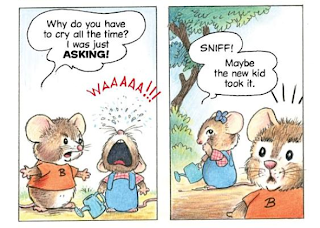
Benny and Penny in The Big No-No! by Geoffrey Hayes

I choose to start with Benny and Penny in the Big No-No! because it won the Theodor Seuss Geisel Award in 2010.  The first thing I noticed were the adorable illustrations!  A far cry from the Anime that kind of turns me off. 


How cute are they?!

I found that the story line about Benny and his little sister Penny was perfect for young readers!  A new neighbor moves in next door.  There is a misunderstanding but in the end the readers see Benny and Penny making a new friend.  The dialogue was pretty basic but there was age-appropriate mystery, drama, and humor that would surely capture the attention of pre-schoolers, kindergarteners, first graders, and some second graders.

Vocabulary: pail, mud pies, and various onomatopoeias (splop, yeow, etc.)

Close Reading Comprehension Questions:
Why do you think Benny hopes the new kid is a boy? p. 7
Why does Penny hope its a girl? p. 7
What do you suppose made those footprints? p. 11
How could Benny's pail have gotten into the other yard? p. 14
What do we know about the new girl? p. 22
How do we know the new girl didn't take Benny's pail? p. 23
What would you do if you were Benny? p. 25

I created a readers theatre script from the book.  With the many benefits of readers theatre, fluency, comprehension, and motivation, to name a few, I decided this would be the perfect use of the text. I actually got the idea to transform a graphic novel into a readers theatre script as a means to increase fluency.  Check out Terry Thompson's book Adventures in Graphica for more awesome ideas about using graphic novels.  Anyway, I take no credit for the script material including dialogue.  Geoffrey Hayes wrote it! I just turned it into a script.  I'm really hoping to use this next spring with some of my kindergarteners.  Feel free to try it also!  Let me know if your students enjoy it!

Overall, I found the story engaging.  I know that many kids are being motivated to read through the medium of graphic novels.  So, I'll embrace them!  Though the dialogue may seem simple at times, it is perfect for emergent readers and very young listeners.  I would recommend Benny and Penny in The Big No-No! to both readers and primary teachers.