Showing posts with label Fluency. Show all posts

Sunday, March 2, 2014

To Dance; A Ballerina's Graphic Novel by Siena Cherson Siegel Illustrated by Mark Siegel


Beautiful is the best description that I could create for To Dance.  Written by Siena Cherson Siegel and illustrated by her husband, Mark Siegel, To Dance is a memoir of Siena's childhood and teenage experiences.  The illustrations depict the loveliness of childhood dreams.  The lines are fluid and the colors are vibrant yet soft.  The memories are just as beautiful, though some are painful.  The beauty is in the idealistic way that young Siena absorbs the world of dance.

This book would be perfect for the unmotivated reader in upper elementary school.  Though older teens may enjoy this graphic novel, as well.  I was engrossed in the storytelling.  Without ignoring reality, To Dance lets the reader dream with Siena.  This novel would not be appropriate for children younger than 10 or 11. Siena shares her thoughts about her body changing and her parents' divorce which may not be suitable for all readers. 

Teachers, librarians, and parents would do well to add this treasure to their collections.  I would not read this book aloud since the interest is quite specific.  Selections of this story may work excellently as passages for practicing fluent reading. Students reading this text may need assistance with difficult vocabulary.  
Vocabulary:  studio, blackout, leotards, bare, audition, pianist, Julliard, administrators, barre, Shamayana, selected, rehearsal, principal dancer, accent, burgundy, plies, tendus, intensified, fleeting, refuge, choreographed, develop

Close Reading Questions: 
Do most people have flat feet?  How can you tell this could be a problem?  
How did Siena's parents support her dreams of becoming a ballerina?
What were some experiences that inspired Siena to be a ballerina?
Why would Siena view ballet as a refuge?
What similarities does she see between football and ballet?
Why might Siena have felt different than normal teenagers?


Wednesday, February 26, 2014

Johnny Boo; The Best Little Ghost in the World by James Kochalka


Johnny Boo is the story a young ghost and his friend, Squiggle.  Johnny Boo and Squiggle play together, sharing the occasional disagreements, as all friends do.  Together, the meet the dreaded Ice Cream Monster, who ends up not being as scary as they imagined.  This silly little tale with delight young readers.


This graphic novel, the first in its series, written by James Kochalka, reads much like a traditional comic book.  Reluctant readers will enjoy the goofy humor and extensive use of onomatopoeia. The text is not very complex and could be read by a first or second grader.  Because of the simplicity and its high-interest appeal, this story would be an excellent text for practicing fluent reading.  Fluent reading is essential for ensuring students comprehend the text.  Pick up a copy for your classroom library and your students will thank you!

There not any words that need explicit vocabulary instruction.

Close Reading Questions:
Do you think that Johnny Boo and Squiggle play together very often?  How can you tell? p. 8
Why was the ice cream melted? p. 21


Saturday, January 18, 2014

The Gingerbread Man Loose in the School by Laura Murray

I must say, this third book is my favorite graphic novel thus far.  The Gingerbread Man Loose in the School by Laura Murray takes the graphic novel to a whole new level.  This story is a twist on the classic Gingerbread Man story.  Check out this promo trailer designed by librarian, children's book editor, and blogger, Carter Higgins.


Laura Murray's incorporation of rhyme appeals to the elementary-aged reader.  Drawing from an activity she did with her own classes, Murray's Gingerbread Man is created by students and is left in the classroom to cool.  But, Gingerbread Man, thinking he has been left behind, journeys through the school in search of the young bakers.  Rather than the traditional repeated line "Run, run as fast as you can.  You can't catch me I'm the gingerbread man." the protagonist proclaims he is trying to catch the class.  This story would be a perfect conclusion to a gingerbread man unit in any primary classroom.  Laura Murray being the teacher that she is, has created an ellaborate unit for teachers.  Check it out!  She has provided oodles of extension activities, suggestions for using the text, and even a recipe if you'd like to make your own gingerbread man.  


Vocabulary: ingredients, complete, announce, "tough cookie," "smart cookie," handrail, spectacular, belong

Close Reading Questions:
From the other stories you have heard about the gingerbread man, what do you think will happen now? p. 7
How could the nurse fix him? p. 12
Where is the gingerbread man?  p. 19
Were we right about our prediction?  p. 21
These pages have a lot of action words or verbs.  Let's list them. p. 24-25
How did the gingerbread man know he was wanted and not forgotten by the class? p. 31
How is the pattern of this story different than The Gingerbread Man by Jim Aylesworth? end


Friday, January 17, 2014

Little Mouse Gets Ready by Jeff Smith

For my second blog entry, I chose another Toon Book, Little Mouse Gets Ready.  This book received a Theodor Seuss Geisel honor award for its efforts in reaching the very young readers.  Its a perfect story for my young kindergarteners!  I hope that you will appreciate it's simplicity as much as I did. 


Little Mouse struggles to get dressed but is clearly proud that he can do it himself-- such a relatable topic for little ones.  Each page describes his efforts to dress for a trip to the barn.  Jeff Smith, author of the award-winning graphic novel series, Bone, includes humor and a surprise ending that kids will enjoy.   Much of the text is decodable for students near the end of kindergarten or first grade.  I am positive preschool children would enjoy hearing this story read aloud. 


There are very few words that typical school-age native English speakers would not know.  However, if your classroom is like mine, there are quite a number of English Language Learners or students with very limited language development.  For that reason, I chose to include words and phrases that I believe ELLs would need explicitly explained.

Vocabulary: barn, "oh boy," sir, tag, oats, tricky, sleeve,

Close Reading Comprehension Questions:
How do we know the Little Mouse has dressed himself before? p. 10
What do you think he will put on next? p. 13 (after first frame)
What could his mama mean? p. 25


Saturday, August 17, 2013

Benny and Penny in The Big No-No! by Geoffrey Hayes

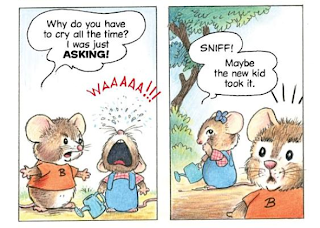
I choose to start with Benny and Penny in the Big No-No! because it won the Theodor Seuss Geisel Award in 2010.  The first thing I noticed were the adorable illustrations!  A far cry from the Anime that kind of turns me off. 


How cute are they?!

I found that the story line about Benny and his little sister Penny was perfect for young readers!  A new neighbor moves in next door.  There is a misunderstanding but in the end the readers see Benny and Penny making a new friend.  The dialogue was pretty basic but there was age-appropriate mystery, drama, and humor that would surely capture the attention of pre-schoolers, kindergarteners, first graders, and some second graders.

Vocabulary: pail, mud pies, and various onomatopoeias (splop, yeow, etc.)

Close Reading Comprehension Questions:
Why do you think Benny hopes the new kid is a boy? p. 7
Why does Penny hope its a girl? p. 7
What do you suppose made those footprints? p. 11
How could Benny's pail have gotten into the other yard? p. 14
What do we know about the new girl? p. 22
How do we know the new girl didn't take Benny's pail? p. 23
What would you do if you were Benny? p. 25

I created a readers theatre script from the book.  With the many benefits of readers theatre, fluency, comprehension, and motivation, to name a few, I decided this would be the perfect use of the text. I actually got the idea to transform a graphic novel into a readers theatre script as a means to increase fluency.  Check out Terry Thompson's book Adventures in Graphica for more awesome ideas about using graphic novels.  Anyway, I take no credit for the script material including dialogue.  Geoffrey Hayes wrote it! I just turned it into a script.  I'm really hoping to use this next spring with some of my kindergarteners.  Feel free to try it also!  Let me know if your students enjoy it!

Overall, I found the story engaging.  I know that many kids are being motivated to read through the medium of graphic novels.  So, I'll embrace them!  Though the dialogue may seem simple at times, it is perfect for emergent readers and very young listeners.  I would recommend Benny and Penny in The Big No-No! to both readers and primary teachers.