Showing posts with label elementary grades. Show all posts

Sunday, March 2, 2014

You Can't Take a Balloon Into the Museum of Fine Arts by Jacqueline Preiss Weitzman and Robin Preiss Glasser


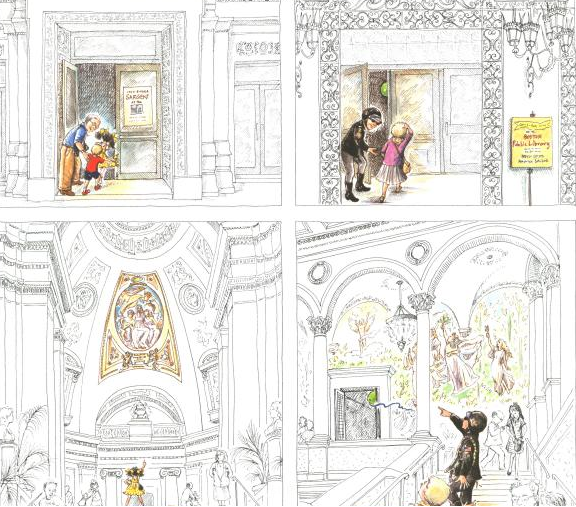
You Can't Take a Balloon Into the Museum of Fine Arts is one of my recent favorites.  This graphic novel explores the city of Boston.  Though this book is completely wordless, the author and illustrator, Jacqueline Preiss Weitzman and Robin Preiss Glasser tell a humorous story of a balloon.  Enjoying a day in the city, grandparents take their grandchildren to the Museum of Fine Arts.  Rather than bringing the granddaughter's green balloon into the museum, the grandmother waits outside with it.  Hilarity ensues as the balloon is accidentally let go.  It travels through the city into various famous and historic places in Boston including the Public Gardens, Old North Church, Boston Harbor, and even Fenway Park, gathering a parade of followers in its wake.  Meanwhile, the children and their grandfather explore the museum; taking in the fine art.

This is the third book in the series.  Weitzman and Glasser previously wrote You Can't Take a Balloon Into the Metropolitan Museum and You Can't Take a Balloon Into the National Gallery.  Appropriate for students at any reading level, words could be created by students during writers workshop. This book would also, serve as an excellent mentor text.  Even though there are no words, the story has a very clear pattern that students could imitate as they create stories of their own.  The pattern is similar to that of The Gingerbread Man or The Mitten.    I would highly recommend this book to any elementary teacher.

Tuesday, February 25, 2014

The Invention of Hugo Cabret by Brian Selznick


By now you've probably heard of The Invention of Hugo Cabret.  If you have not or you've been putting off reading this modern classic, read it--now!  By author Brian Selznick, Hugo is an enchanting tale of mystery, magic, and friendship. The story follows a young orphan named Hugo.  He resides in a Paris railway station where he secretly cares for the clocks after the disappearance of his drunken uncle.  This, however, is not the biggest mystery surrounding Hugo.  He spends his spare time repairing a mysterious object left to him by his father.  Hugo finds himself unwilling entwined with a shopkeeper with his own secrets and his goddaughter. Through these unbidden friendships Hugo discovers answers and learns to trust.


This Caldecott Medal winner is beautifully illustrated by the author.  Double-paged drawings are found throughout the book.  There are so many illustrations that this story can easily be classified as a graphic novel.  These graphics move much of the story along when words are not enough.  Text does not even begin until page 46.


The would be an excellent read aloud for first- third graders.  This story could easily be used to teach comprehension strategies.  Though brimming with illustrations, the language in this book has the potential to create excellent mental images.  The mystery and wonder from cover to cover lends itself to questioning. Beyond comprehension, the vocabulary in this book is phenomenal.  I couldn't possibly list all the possibilities for vocab, but I choose several as a jumping off point.  You may choose to add more depending on your students' needs.

Vocabulary words: perch, agitated, thief, Station Inspector, scavenge, decrepit, intricate, artificial, lull, optimistic, trance, cavernous, mythology, guidance, divert, instinctively

Close Reading Questions:
Why does Hugo rub the notebook?  p. 51
What do you think Hugo was going to do with the gears, nails, and cogs? p. 52-53
Who is the author implying still lives in the train station?  p. 76
Why do you think Hugo is taking care of the clocks instead of his uncle? p. 77
Why is it so important to Hugo that he get his notebook back?  p. 120
Do you think Hugo would be less alone if he fixes the automaton?  p. 131
Would Hugo be happier if he didn't have so many secrets?  p. 205
Why do you think the old man saved the wind-up  mouse? p. 306
How do we know the old man didn't want people to know about his past? p. 385
How do we know Hugo changed his mind about secrets? p. 481
How did the automaton save Hugo's life? p. 510
Who is telling this story? p. 511


Saturday, January 18, 2014

The Boxcar Children; A Graphic Novel by Gertrude Chandler Warner


If you were anything like me as a child, you were thoroughly engrossed by The Boxcar Children.  I still remember the excitement of wondering if Henry, Jessie, Violet, and Benny could make it on their own.   What child does not delight in the idea of having a little home in the woods-- like playing house, only better! Making a "refrigerator" in a stream, foraging for food in the forest, a hunting for treasures in the dump, and rescuing a stray dog; nursing him back to health.  I know I'm not alone; Gertrude Chandler Warner's story has beautifully enchanted generations of readers.  Now, as a teacher, I have read this tale to my students and each time I have seen the same wonder.


Well, this collection of books has now been adapted into a graphic novel series.  Graphic novels, you may know, are an excellent way to engage the struggling and/or reluctant readers in your classroom or home.  They provide increased opportunities for visualization and may improve comprehension.  And bonus, they are quite appealing to the less engaged reader.  Check out this excellent article from School Library Journal for more info about graphic novels.

Anyway, back to The Boxcar Children!  This newly adapted series by Shannon Eric Denton, illustrated by Mike Dubisch, brings to life our favorite characters and delights a new generation of readers.  Each page relates the very same old story in this relatively new genre.  Consider bringing this graphic novel version into your classroom library or maybe just your personal collection!

As I mentioned in a previous blog entry, I work with many ELLs and other students with limited English language development.  I am including vocabulary words/phrases that I choose to frontload for my kindergarten students. Depending on the grade level you teach, your list may differ from mine.

Vocabulary: bakery, a "children's home," haystack, boxcar, brook, a dump, stew, spare, orchard, thrilled

Close Reading Questions:
How do we know the baker and his wife don't really want to help the Aldens? p. 7
Why did the children sleep so long? p. 8
Why did the boxcar make a good place to stay?  p. 12
How do we know the children must have had some money? p. 14
What could Henry do with the hammer and nails?  p. 20
Why do you think Dr. Moore wanted Henry to go to the Free-for-all?  Think about what he just read in the newspaper.  p. 23
I wonder how Dr. Moore knew just where to go.  How could he have known?  p. 25 (after the first frame)
What evidence do we have that Grandfather is rich?  p. 30
Do you think the children will be happy living with Grandfather?  What makes you think so?  p. 31